Monday, March 13, 2017

My Struggle to Bring Life to My Historical Novel by Joan Donaldson-Yarmey


To celebrate Canada’s 150th birthday Books We Love Ltd is publishing twelve historical novels, one for each of the ten provinces, one for the Yukon Territory, and one combining the Northwest Territories and Nunavut. We Canadian authors were asked to pick one of the provinces or territories to write about or to do the research on for a non-Canadian author. I chose the Yukon because I have been there twice and love the beauty and history of the territory. The following is a quick summary of some of the struggles I have to bring life to my novels.

Struggles to bring my story to life.

I have written in many different genres, non-fiction, mystery, romance, and historical and in each one I have had to make sure that my characters are multi-dimensional, my story plot is fast paced, and my setting is exciting. Readers what to identify with the main characters so they have to be believable and likeable. Readers want action in the story so the plot has to move along at a good clip. And readers want to learn about the place where the story is set, so it is important that I know the setting itself. This is much harder in a historical novel because that setting is no longer readily available in the way it was in the time period I am writing about. So this is where non-fiction books, museums, archives, and paintings or photos of that time come in handy.

     In any novel it is important to make sure the plot moves forward, the characters grow, and the setting is described at the same pace but, for me, it isn’t necessary to write that forward movement in sequence.

     I imagine I am like most authors in that I never write a book in the order that the reader will read it. As I am writing the first chapter, later scenes develop in my mind and I will jot down notes on them. When I come to a standstill in the progress of the story, I turn those notes into the scene. That way I seldom have writer’s block. And it gives my subconscious mind a chance to work out the next stage in my story.

     Sometimes I have an idea as to the ending of my novel but I never write it down because it is subject to change at the whim of the characters for, although I am the writer, it is their story.

Sunday, March 12, 2017

How the Calgary Stampede Inspired My Murder Mystery Novel


For more information about Susan Calder's books, or to purchase, please visit her Books We Love Author Page http://bookswelove.net/authors/calder-susan/


How the Calgary Stampede Inspired my Murder Mystery Novel
My first published writing was a travel article about the Calgary Stampede in The Montreal Gazette newspaper (May 1, 1993). At the time, I was living in Montreal and had no clue I’d be moving to Calgary three years later. 
Saddledome, fairgrounds site and Calgary skyline

In the summer of 1992, my husband and I had made a trip west with our two young sons. Our holiday goals were to see the Rocky Mountains and visit a cousin who lived in Calgary. As I was looking through travel information, I noticed we’d arrive in Calgary the last day of the Stampede. Why not buy tickets to the rodeo? I didn’t expect the festival to be much more than that and didn’t allow any time for other Stampede activities.

When we got to the fairgrounds, I was surprised by the extent of the offerings. A hilarious hypnosis show, many other shows, midway rides, a marketplace. I even liked the food. And we didn’t touch on all the rest—the downtown parade on opening day, free pancake breakfasts, everyone dressed in western wear, stores decked out with bales of hay, the party atmosphere in the city.
Calgary Stampede parade

I figured if I was ignorant of the Stampede’s scope, it’s likely my fellow Montrealers were too. In the fall, I signed up for my first creative writing course, Magazine Writing. Our final assignment was to write a non-fiction piece and a query letter targeted at a specific magazine or newspaper. I was an avid reader of The Gazette travel section and wrote an article about our visit to the Stampede. The teacher liked the piece, so I sent the query to The Gazette travel editor.

Little did I know how slowly the publishing industry generally operates. I also didn’t know that rejection was par for the course. When several months passed with no reply, I was despondent. Then I got the call. The editor was enthused about my idea. He especially liked the family angle.
“Most people I hear from are yuppies,” he said.
Who knew something ordinary like having kids would be a selling point?
I couldn’t stop smiling for days. My writing career was launched. A couple of weeks later, my feature titled “Canada’s Wild West: The Calgary Stampede” appeared on the front page of The Gazette travel section.

While I went on to write three more travel articles for this editor, I discovered how hard it was to break into other publishing. I queried magazines with travel ideas and got no interest. So I returned to my first love, fiction, and wrote novels and short stories. As the years went on, I learned that publishing acceptances are rare. 
Finally, a small press accepted my murder mystery novel set in Calgary, my current hometown. It struck me this book could become a series. Since its title was Deadly Fall, I decided the next books in the series would take place in Calgary's other three seasons. I settled on summer for book two. For me, summer in Calgary means the Stampede. My new novel Ten Days in Summer, set against a backdrop of the Calgary Stampede, feels like a return to my writing roots and the article that made me a published writer.
My husband Will and me at the Stampede parade

I still enjoy the Stampede as much as I did on that first visit. During my 20 years in Calgary, I’ve come to know it more. I rarely miss the fairgrounds and the parade, usually catch a pancake breakfast and have acquired some western wear. Stampede is like Calgary’s Mardi Gras, or two weeks of western-themed Hallowe’en that takes over the whole city. I hope my novel Ten Days in Summer captures some of this atmosphere.  
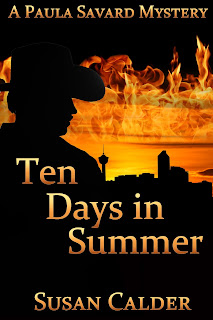
I wanted the cover of my new novel to include a Stampede image. BWL designer Michelle Lee came up with this striking silhouette of a cowboy against a background of the Calgary skyline and the fire that sets off the novel action. 


If you're in Calgary this Tuesday, please join me at my book launch for Ten Days in Summer: Tuesday, March 14, 2017, 7:00-8:30 p.m. Owl's Nest Bookstore, Britannia Shopping Plaza on Elbow Drive at 49th Avenue, 815 49th Avenue SW, Calgary. Free. Refreshments. Everyone welcome. RSVPs are appreciated but not required. contact@owlsnestbooks or (403) 287-9557.   


Saturday, March 11, 2017

Is The Font Information Publishers Use (and let the reader know) Necessary? by Karla Stover

Right now, I have four library books on my night stand: two published by Simon and Schuster, one by Putnam, and one by Random House. Random House included the information that the book was set in Dante, "a typeface designed by Giovanni Mardersteig (1892 - 1977) for his own printing business, the Officina Bodoni." I find the punctuation in this font hard to find, let alone read.

I read up on Mr. Mardersteig and then popped over to Random House, thinking I'd give them a call. Their website doesn't have a phone number, so I sent an email. In the meantime, I read that Random House was started by two men, one of whom was Bennett Cerf. When I was little, my folks watched What's My Line, and he was part of the panel. How nice to inadvertently run into an old friend.

I, of course, Googled around and found only three comments on including font information in books. Apparently, font facts aren't an issue with many readers--more's the pity, but here's what those three had to say:

1. Why not? It takes up only a few words out of the entire page of book info anyway. Besides, type nerds like me like knowing the font used, and the publishers probably got tired of telling people in their emails that the font used was.

2. There's a certain amount of guesswork on my part, but I suppose it has to do with copyright. Fonts can be copyrighted. Someone has to create them after all. Publishers hold the concept of copyright in very high regard, so it stands to reason that they would want to give the font creator due credit.

Product Details3. It brings peace and serenity to our minds in a world full of . . . Comic Sans.

I like knowing things such as fonts used and, getting back What's My Line, panelist Dorothy Kilgallen died a mysterious death while researching the Warren Committee's findings on the killing of President Kennedy. I read her biography. And I carefully researched my two murder mysteries. In A Line to Murder, the protagonist visits a former hippy commune. I visited an active commune. She goes to a psychic fair, so I did, too. She works with senior women in a retirement home and I do volunteer work at a soldier's home.

Murder: When One Isn't Enough takes place mostly on Hood Canal. My family has had summer homes there since the late 1950s. I know the area and the history. I've been to many Tahuya Days festivals and own a copy of Madame of the House, the book around which the story takes place.

Random House just responded to my email, asking which book I was referring to. If I get an answer, I'll post it. In the meantime, back to my historical fiction (but well-researched) novel.


Product Details

Popular Posts

Books We Love Insider Blog

Blog Archive