Monday, July 17, 2017

Series and How They Began

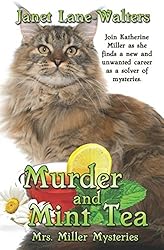
Murder and Mint Tea (Mrs. Miller Mysteries)


Murder and Mint Tea started the mystery series featuring Katherine Miller, retired nurse and retired church organist. Though she doesn't wait a third career, bodies seem to find her. This began as a short story that was rejected with this comment "This sounds like the synopsis for a novel." I then had to learn how to write novels. For a number of years the short story and the letter sat in my file cabinet gathering dust. Then I found the story and soon had the story broken down to an outline for a book. The book sold well, even had a version on tape. Because of this, I set out to write a second and a third. I'm now working on the sixth to be released when it's done. Murder and Sweet Tea.


The second series I'll talk about is a four book YA written under J. L. Walters. This was a bit different for the start. I tell myself stories as I'm falling asleep. The written plan for the book came to over 100 pages so I knew I had to write what I thought was a trilogy, except it turned into four books. The story followed the coming of age of two sets of twins from the destruction of their home to the ending of the villain.
Product Details


I do have other series but they're not complete. There is the Moon Child series based on six women who have July birthdays and how they meet the men of their lives. The second is Opposites where the opposite signs of the Zodiac women meet the men of their dreams. There is the Seduction series that is complete.

Sunday, July 16, 2017

Bears and more bears at Killbear by J.C. Kavanagh


The Twisted Climb - BEST Young Adult Book 2016, P&E Readers' Poll
Camping is always an adventure. At least it is when I camp. Reserving at a campground called 'Killbear' should be the first indicator of what might be in store during your camping vacation. Not killing bears, of course (though I don't know why they would call it Killbear) - but dealing with bears. Big, medium and small. Bears during the day. And bears bears bears at night.

Don't be spooked. They usually just pass through, unless of course, you have foolishly abandoned your site, leaving a feast-fit-for-a-bear on the table.


And you have ignored this sign:


Notice the white sign with red lettering? Active bear in campground. That means a pesky, stubborn, uncooperative bear is lurking in the bush, just waiting for the novice camper to leave food and coolers unattended. Beware. Bears know how to open coolers. They're smart, you know. And they have hands. Or paws/feet, whatever. They can open things.
The black bears found at Killbear Provincial Park, near Parry Sound, Ontario (Canada), are typically shy and only forage at night when you're sleeping. I don't like to think about the fact that a micro-thin piece of nylon tent separates me from the wandering bear(s).
Bear trap - baited with stale Tim-Bit donuts!
A few years ago at Killbear, we were enjoying some beverages around the campfire when we heard the sound of dishes and cutlery and pots clattering together, as if the large Rubbermaid container they were stored in had tipped over.
Sure enough, the tip-over was genuine as was the large, hulking bear with his snout in the bin. I quickly stood up, careful not to spill my wine, and shouted, "GIT!" (I think "GIT" was hill-billy-speak for "Go on now, get going." The word "GIT" could also be attributed to alcohol consumption as one syllable is much easier to pronounce.)
And so with several glasses of 'brave' under my belt, I continued to scold the bear and walked toward it with my glass of wine held high in the air, as if that was my weapon of choice. The bear turned and scrambled away. Oh, but I was not finished. Taking a big gulp, I charged forward, berating the creature at regular intervals: GIT, GIT, GIT!
Oh, I was bold. The hefty black bear scampered ahead of me, much like a child caught with its hand in the cookie jar and refusing to make eye contact. After stalking it for about 50 metres, I stopped. It was dark and I didn't bring my flashlight. A few glasses of brave will only give you so much brave.
I turned and walked back to the glow of the campfire, curious as to what the bear found so irresistible in the bin.
Family members stood around the bin, each with a flashlight in hand. Items were sorted and there it was. The irresistible culprit. A vanilla-scented candle. Seems the son-in-law thought the candle would be a deterrent for mosquitos. He forgot that vanilla scent is an attraction for bears. And family being family, we've never let him forget it.
I'll be camping at Killbear again this year. In fact, as you're reading this, I'll be bear-proofing my site and wishing I had the walls of a sleek, thick-walled trailer.
But not to worry, I shall have my glass (or two) of brave.

Enjoy life!


J.C. Kavanagh
The Twisted Climb
BEST Young Adult Book 2016, P&E Readers' Poll
A novel for teens, young adults and adults young at heart
Email: author.j.c.kavanagh@gmail.com
Twitter @JCKavanagh1 (Author J.C. Kavanagh)

Saturday, July 15, 2017

When Writers Can’t Write Anymore


Hemmingway in Idaho


            Every writer lives with a great fear: the loss of ability to continue writing. Often, it is writer’s block, mostly caused by poor plotting or structural problems in a manuscript, but sometimes, it may have a more serious origin.

            On July 2, 1961, fifty-seven years ago, in Ketchum, Idaho, Ernest Hemmingway killed himself with a shotgun blast. In the spring of the same year, he had been requested to contribute a single sentence for a presentation volume marking President John F. Kennedy’s inauguration. He told his lifelong friend and biographer, A.E. Hotchner: “It just won’t come anymore,” and wept.

            It was a year earlier, in 1960, that Hemmingway discovered that he could no longer write. It turned out to be a devastating blow to a prolific author who deeply connected his self-worth with his creativity. That discovery triggered a deep depression from which he could not escape.

            In some ways, Hemmingway was uniquely vulnerable to depression. Part of it was hereditary: his father had committed suicide in 1928, ironically enough, in the manner. His grandfather, brother, sister and granddaughter all did the same. Hemmingway also suffered from an enormous list of medical conditions: bi-polar mood disorder, chronic alcoholism, brain injuries and hemochromatosis, a disease that results in damage to the internal organs and is linked with depression. He also had a morbid fascination with guns and death; as a child hunting in the Michigan wilderness; as a correspondent covering the Spanish Civil war and in the uncounted hundreds of big game he killed in Africa. Indeed the pages of his works are filled with violent death, whether human or animal.

            Yet, writers as a group are particularly vulnerable to depression. In an article titled “The Neurological Similarities between Successful Writers and the Mentally Ill,” Cody Delistraty[1] lists several reasons for this. Writers think a lot, and people entangled in their thoughts tend to be withdrawn. He says, “add long periods of isolation and high levels of narcissism that draws someone to a career like writing, and it seems obvious why they may not be the happiest bunch.” Other findings suggest an unusually high percentage of alcoholics in the writing community.

            But brain science may give a clearer explanation. In the same article, a connection between creativity and the inability to suppress the precuneus portion of the brain is suggested. The precuneus part of the brain regulates self-consciousness, memory and creativity. For ordinary people, it is most active during rest, when the brain is allowed to “day-dream.” For creatives, however, it doesn’t turn off.  And this may explain why the best writers find unusual associations and unique, even bizarre, ways of looking at the world. They cannot stop thinking. Unfortunately, this condition is also tied in with depression.

            Hemmingway is a classic example of misdiagnosed, or even undiagnosed, mental illness. Today, our understanding of mental illness has significantly advanced and cures are more readily available. One can only wonder what further works of genius he might have produced had such treatments been available during his decline.


[1] https://thoughtcatalog.com/cody-delistraty/2014/03/the-neurological-similarities-between-successful-writers-and-the-mentally-ill/


Mohan Ashtakala is the author of "The Yoga Zapper" (www.yogazapper.com) published by Books We love (www.bookswelove.net)

Popular Posts

Books We Love Insider Blog

Blog Archive