Saturday, February 11, 2023

Hidden in Plain Sight by Karla Stover


When I had my radio show and newspaper column, I was always looking for something interesting to share. One day I was browsing through old news papers and I came across a local woman who had become a camouflage artist during World War I. The article was so interesting, I read everything I could find about the Women's Reserve Camouflage Corps. which gave the nucleus for my next book.

Camouflage was developed in France  by artists such as  Lucien-Victor Guirand de Scevola, all of whom loved its theatrical nature. By1914 they experimented in attempts to hide military personnel, actions on the battlefields and the battlefields themselves. In 1917, a British artist named Norman Wilkinson came up with the idea to disguise ships by painting them with  optical illusions. His proposal to the Royal Navy was accepted and at his studio five designers began creating designs.  Eleven female artists went to work and between spring 1917 and autumn 1918 had "razzle dazzled", as the technique was called, more than 2,300 ships.  

Meanwhile, in the United States, it was becoming increasingly apparent that the U.S. would be entering the war. As a result, the Women's Reserve Camouflage Corps" was created. It was a "specialized unit of American female artists" tasked to "design and test camouflage techniques for the military." Before camouflage clothing came along, some soldiers rubbed mud on their clothing or painted their uniforms with splotches and lines.  But now, women were creating clothing that resembled the landscape, and that included suits resembling rocks or tree trunks for use by snipers. They help make fake tree limbs, fake trees, and disguises for equipment. Need to draw the fire, Put a phony head where the enemy could see it. While serving as a Second Lieutenant of Engineers in France, an American named Homer Saint Guadens saw how cotton for blankets was in short supply, and found a way to make blankets by recycling paper. The patterns created soon led to using green, brown or grey on the material. Snipers and scouts hid underneath one and inched along the ground. 

Behind enemy lines women made nets out of wire up to 37 feet long out of wire and fishnet to drape over tanks and conceal them from enemy aircraft. They made garlands out of green burlap to hang from trees and painted to disguise giant umbrellas. Their ages ranged from 14 to 65. 

As for the Tacoma girl, after the war she married a banker and lived in the Midwest. But she didn't forget her Puget Sound roots and endowed a building at a local seminary. I have plenty to work with. Now, will someone please crack a whip under me.


Thursday, February 9, 2023

He’s Determined to Ski Again – Barbara Baker


In 1937, when Dad was five-years-old, he learned to ski in his hometown, Partenkirchen, Germany. His first pair of skis were handmade. 

Years later when he started racing, he crashed while training and broke his femur. He said it was hours before ski patrollers found him because he’d flown off the course and into the trees.

While he was in the hospital, with his leg in traction and strapped to a sky hook, bombs shook the building. Nurses ran through the ward shouting for patients to get under their beds. Dad laughs when he tells the story and says all he could do was put a pillow over his head.

Dad has skied all his life but took a two-year hiatus when he was 88 years old so he could have a long-over-due knee replacement. After the surgery, he exercised. He walked. He exercised some more. He was determined to ski again.

On January 10, 2023, we arrived at the Mt. Norquay ski resort, outside of Banff, well before the lifts opened. I forced myself to slow down - my walking, my talking (I can be a chatterbox). I wanted to focus on Dad and be helpful without him asking.

Boots on, skis on, poles in hand, we headed to the beginner hill. I stayed beside him as he tested out sliding and then climbing up the slope. Each time he climbed a bit higher.

Snow plow turns first. Then the stem christie maneuver. The parallel turns proved to be trickier. Dad’s new knee worked just fine and the leg slid nicely into place. But the old knee, which was used to being in charge for decades, was pushy and uncooperative. It rushed ahead of the uphill ski and Dad would have to stop to reposition himself.

After a few equipment adjustments and more practice, Dad was ready to go up the lift.

“Can you ask the liftie to slow it down?” he said as we got our tickets scanned at the Cascade chairlift.

I took a breath and gave a silent prayer to whomever was listening.

“Can you please slow it down,” I said to the lift operator. “He’s ninety. Testing out his new knee.”

“No problem,” the Aussie accented girl replied. “Just wave to the operator at the top and he’ll slow it down again for you to get off.”

“Perfect.”

The chair swung around and scooped us up. Dad scanned the run. He was quiet. So was I. As we got to the last tower I waved at the guy in the hut. He flagged a thumbs up. I nodded.

“I don’t know if I can stand,” Dad said.

I moved right next to him and squeezed his bicep. “I’ll just shuck you off if you can’t get up.”

He laughed. “You would, wouldn’t you?”

 After an uneventful exit we stood at the top and looked down the run. Dad nodded and slid his skis back and forth. Away he went. Again, I held my breath and followed but not too close. I didn’t want to rush him.

It took a few runs but soon his perfect parallel turns, quiet body and graceful carving cut across and down the slope.

The smile on his face, the sweat dripping down his cheeks and the twinkle in his eyes made all my fears and angst melt away.

He did it. Dad skied again.

Watch Dad ski again:  Dad Skiing Again - 90 years young - YouTube

You can contact me at: bbaker.write@gmail.com

Summer of Lies: Baker, Barbara:9780228615774: Books - Amazon.ca

What About Me?: Sequel to Summer of Lies : Baker, Barbara: Amazon.ca: Books


Wednesday, February 8, 2023

How to Make a Killing Writing Murder Mystery by Vanessa C. Hawkins


 Vanessa Hawkins Author Page


    So if you've been keeping track of the Books We Love Website (which... if you haven't, why not?) then you know that the upcoming Canadian Historical Mystery Series is on its way! My book, entitled Twice Hung, is the tenth book in this exciting new venture, and I am excited to tell you a little bit about it. 


It's a murder mystery. 


    No, but seriously, it will be one of the first serious mystery novels that I've wrote, and while I've been doing a ton of research on how to create some good mystery, I have come across a few tips I thought I'd share with ya'll because... well, I luv ya all a bit! 


I was going to pick meme that highlighted how much I loved my blog readers but... 
this meme was way more me...

So NUMBER ONE!

The Victim: Yeah, they may not be around much, but they are still very important to the story. Whether or not your mystery started with their untimely demise, it's important to know about the events that led up to it. Who was your victim and why did someone want them dead? Why were they in the wrong place at the wrong time, and/or what was their relationship to the killer? What is also important was their character. Did they have it coming, or should we sympathize with the newly dead? 

TWO!

The Murderer: This may be the most interesting character in your story, after the main protagonist. Knowing who they are is essential in creating not only a great story, but one that keep readers turning pages. I love gray area people, and by that I mean creating characters (not just antagonists) with a bunch of flaws. I believe its a key to being human and gives writers a way to allow their protagonists to overcome personal obstacles. How is the murderer similar to the protagonist? How are they different? Do we sympathize with them at all? Keep your reader guessing. 

THREE! 

Red Herrings: Mysteries are the most fun when there are plenty of twists involved. However, that sometimes means keeping one step ahead of your readers. Subtle hints are key, but give too many and they may guess the end before it comes. Think George R. R. Martin and Jon Snow... (Maybe that's the REAL reason he hasn't finished the books, because everyone had already guessed the ending.)

FOUR!

Foreshadowing: As mentioned above, suble keys are great, especially when you finally get to the "Ah ha!" moment. If the ending doesn't make sense, or seems out of left field, it's probably because it is, and because you didn't leave enough puzzle pieces for the reader to collect. This can really make or break a mystery for me, because if the ending doesn't seem justified, it just makes me think that the author was too dumb to outsmart me and if that's the case then... wow... really?

... it's possible...

 FIVE!

Beta Readers: Get someone else to read your book when you are done. This applies to anything you write, but is especially important for mystery novels. It's hard to know if the clues you left behind were sufficient or way too obvious, but for a beta reader, they can tell you if they saw the ending from a mile away, or if it didn't pack enough punch. 

So that's it. My sure fire way to create a mystery novel. I'm sure there are way more tips, but these were my integral five. Twice Hung will be out next year, and I am so excited! In the meantime, check out the cover image, and head on over to Books We Love to discover more about the series and read some super exciting blurbs! 

Cheers! 


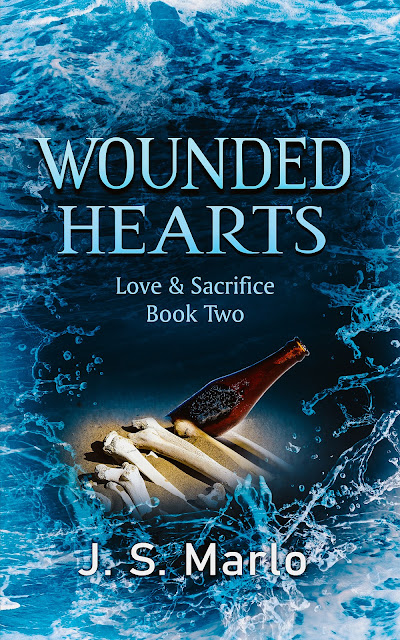
Winter by J. S. Marlo


Wounded Hearts
"Love & Sacrifice #2"
is now available  
click here 


     Before I published my first novel, I wrote stories for fun and posted them on a fanfic website. Many of these early stories took place in winter. Why winter? Because I'm Canadian and I live in the north. I have four seasons: Spring (lasts 1 month), Summer (lasts 3 months), Fall (last 2 months), and Winter (last 6 months). So, I spend half the year in the snow and the cold.


In one of these fun stories, my character was forced to drive in a snowstorm without winter tires. Needless to say, he ended up in a ditch. After reading that story, a reader sent me a message asking me what were winter tires, and why we didn't put 'normal' tires on our cars in Canada. I told her that winter tires look like 'normal' tires but they have a higher natural rubber content to keep them supple in cold weather and deeper & thicker treads, allowing for better grip and handling on snow and ice.


She lived in a part of the world where it's always warm, so she didn't understand how snow, ice, and cold could affect our lives differently. It was the start of a long conversation about car accessories: winter tires, studs, chains, winter wipers, block heaters, battery blankets... then houses: triple windows, insulated attics, basements, furnaces...


Looking back, I learned a lot from the exchange. I realized just because I knew about certain things didn't mean everyone else did. Sentences like "it's cold out" or "there are northern lights in the sky" doesn't mean anything to someone who'd never felt cold or seen northern lights.

As a result, I learned to become more descriptive, to look at a scene through my characters' eyes as if they were seeing it for the first time, and to assume that at least one of my readers will never have experienced what my characters see, hear, feel, sense, or smell.


Happy Reading & Stay Safe! J.S.


Tuesday, February 7, 2023

All the Furs and Feathers by Eileen O'Finlan


I am super excited to annouce the release of my new novel, All the Furs and Feathers Book 1 in the Cat Tales series!

All the Furs and Feathers is the story of two cat sisters, Smokey and Autumn Amelia. Smokey is an architect working for Fluffington ArCATechture. Autumn Amelia is a chef savant. When Smokey get the assignment of her dreams to design Faunaburg's first ever cat park, she quickly realizes it could turn into her worst nightmare. The land parcel for the park is adjacent to Rodent Way. Given the long-standing animosity between felines and rodents this can only spell trouble. She'll need the help of her adorably quirky sister to convince the rodents that the cats' good intentions are for real.

I'm often asked what age group best suits All the Furs and Feathers. Middle graders and up would certainly understand and enjoy it. However, I actually wrote it with adults in mind. Several years ago I was a member of an online community where all participants were cats. Each member's cat had its own page with pictures and a link to that cat's diary if they chose to keep one. The cats could all friend each other, send each other virtual gifts, and message each other. Very popular were the threads in which cats got together for virtual parties, trips, games, and weddings. Most of the humans behind the cats were adults. And we had a blast! Some folks who were good at photoshop would put the cats in clothes and include pictures of them in the threads. My Smokey even got married on the site. It was these people I had in mind as I wrote the story. So, while I will be thrilled to hear that kids are enjoying the book, I am also very gratified by the many adults I've heard from who are delighting in it as well.

If you're wondering what a cat wedding is like, here's a picture of Smokey's:

Popular Posts

Books We Love Insider Blog

Blog Archive